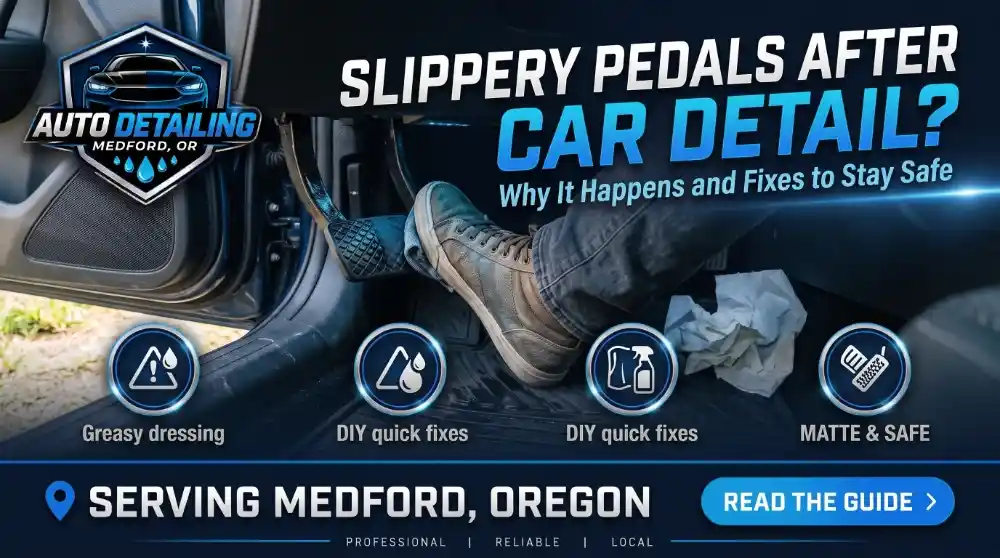
Slippery Pedals After a Car Detail: Why It Happens and How to Fix It
You climb into a freshly detailed car, press the brake, and your foot slides a little. That is not a “good shine.” Slippery pedals after a car detail are a safety problem, and they almost always come from the same cause: too much greasy dressing in the wrong places.
Why do pedals get slippery after a detail?
Most shiny interior and tire products are made with silicone or oil. They are meant to sit on dashboards, door panels and tires. When they are sprayed too heavily, or wiped onto pedals, floor mats and the steering wheel, they leave a slick film that your shoe or hand cannot grip.
Why Pedals Matter More Than Other Surfaces
A shiny dash is only a looks problem. A slick pedal is a control problem. Your foot has to feel small changes in pressure to brake smoothly, and a film of silicone under the sole takes that feel away. The contact area is small, the pedal is often angled, and the shoe is already carrying water, dust or a bit of gravel from a Rogue Valley driveway. A little slip at the wrong moment, like stopping on a wet downhill road off Highway 99, is all it takes to turn a minor mistake into a close call.
That is why pedals, mats, the steering wheel and the shifter should be no-shine zones.
What Is Actually Making the Surface Slick
Dressing products add a thin layer that gives plastic and rubber a darker, wetter look. That layer is what feels slippery. It does not dry hard like paint. It stays soft, and it can move.
A few things make it worse.
- Too much product. A light wipe leaves a dry feel. A heavy spray leaves a film that never fully soaks in.
- Wrong place. Dressing belongs on tires, dash tops and some trim. It does not belong on anything your body touches to control the car.
- Heat. A car parked in a Rogue Valley summer can get very hot inside. Heat softens the film and lets it creep onto nearby surfaces, including the floor and pedals.
- Wet shoes. In Medford’s rainy months, damp soles on an oily pedal are a bad mix.
Where Dressing Belongs and Where It Does Not
|
Surface |
Dressing? |
Why |
|---|---|---|
|
Tires |
Yes, lightly |
Keeps rubber looking clean, but heavy amounts can sling onto paint |
|
Dash top and door panels |
Light, dry-touch finish |
Matte looks cleaner and attracts less dust |
|
Pedals |
No |
Your foot needs grip |
|
Floor mats |
No |
Slick mats let heels slide, and rubber mats can feel dangerous |
|
Steering wheel |
No |
Hands need control, not shine |
|
Shifter and handbrake |
No |
Same reason |
If a product label says “high gloss” or “wet look,” keep it off anything you touch while driving.
How to Check Your Car Right Now
You do not need tools. Sit in the driver’s seat with the door open and check these in order.
- Press each pedal with your hand. It should feel grippy, not smooth like glass.
- Run a clean paper towel across the pedal. Any shine or smear on the towel means there is product on it.
- Press your shoe sole on the driver mat and push forward. It should not slide.
- Wipe the steering wheel with a dry white cloth. Streaks mean it was dressed.
If you find any of this, deal with it before driving. A car is not the place to find out your foot slipped.
How to Fix Slippery Pedals After Car Detail Work at Home
The goal is to remove the film, not to add anything on top.
- Start with a gentle cleaner. A mild interior cleaner on a clean microfiber cloth works for most rubber pedals and mats. Wipe, then wipe again with a clean dry cloth.
- Step up carefully if needed. For stubborn rubber, a cloth lightly dampened with a mix of isopropyl alcohol and water can cut the film. Test a small hidden spot first. Do not use it on leather, painted trim or clear plastic, since it can dull or dry them out.
- Rinse rubber mats. Take rubber mats out, wash them with soap and water, and let them dry fully before putting them back.
- Skip the steering wheel shortcuts. For a slick wheel, use a mild interior cleaner and a soft cloth. Avoid harsh solvents.
- Recheck. Repeat the pedal and shoe tests from the list above before you drive.
If slippery pedals after a car detail keep coming back, the likely cause is product deep in the rubber texture. If you cannot get the surface grippy again, take the car back to the detailer or get it professionally cleaned. Do not drive on pedals that still feel slick.
Why the Tires Matter Too
Tire dressing is the most common culprit outside the car. When applied heavily, it can sling off the tire as you drive and land on the paint along the lower doors, where it leaves oily streaks. Some detailers skip glossy tire dressing for exactly this reason and leave tires clean with a light, dry finish.
It also travels inside. Shoes that step through a tire-dressed wheel well, or a tire product on your hands, can carry that slickness onto the pedals. If you have just had your tires dressed, wipe your soles before you get in. Our Exterior Detailing page covers how wheels, tires and paint are handled.
What a Good Interior Finish Should Feel Like
A properly finished interior does not feel oily. Plastic should look clean and a little matte. Leather should feel soft but dry. Rubber and carpet should feel like themselves, grippy and plain. If you can see a wet sheen on anything you touch with your hands or feet, it has too much product on it.
We cover a full list of spots to look at in our car detail checklist, including pedals and mats, so you can check everything at the handoff.
A Note on Protectants and Sun
Medford’s UV is strong, and some protectant on the dash does help slow fading and cracking. The key is the finish. A good protectant goes on thin, gets buffed off, and leaves a dry-to-the-touch surface. If a product leaves a film that smears when you touch it, there is too much on there, no matter how good the label sounds.
What to Ask Before You Book
You can avoid this problem before it starts. When you call a detailer, ask two simple questions.
- Do you use a matte or dry-touch finish on the interior?
- Do you keep dressing off pedals, mats and the steering wheel?
A good answer is short and confident. Our Interior Detailing service covers the interior surfaces in a detail, so if you have a preference, mention it when you book. It is much easier to say it up front than to fix it afterward.