Automatic Car Wash Swirl Marks: Why They Happen
You take your car through an automatic wash because it is fast and easy. A few minutes later, it looks clean. Then a few weeks or months go by, and you notice something under direct sunlight or a parking lot light. Tiny circular scratches all over the hood, the doors, and the trunk, what’s known as automatic car wash swirl marks, and one of the most common results of regular trips through a tunnel wash.
This does not mean you did anything wrong by using one. It just helps to understand what is actually happening inside that wash tunnel, so you can decide if it is worth the tradeoff for your car.
What Automatic Car Wash Swirl Marks Actually Are
Swirl marks are very fine, shallow scratches in the clear coat, which is the thin protective layer sitting on top of your car’s paint color. They are called swirl marks because they usually show up in a circular or swirling pattern, which is a clue about how they got there in the first place.
On their own, swirl marks are not dangerous to a car and do not affect how it drives. But they do make paint look duller and less glossy, especially under strong light, and over time enough of them can make even a well-kept car look older than it actually is.
Why Automatic Washes Cause This
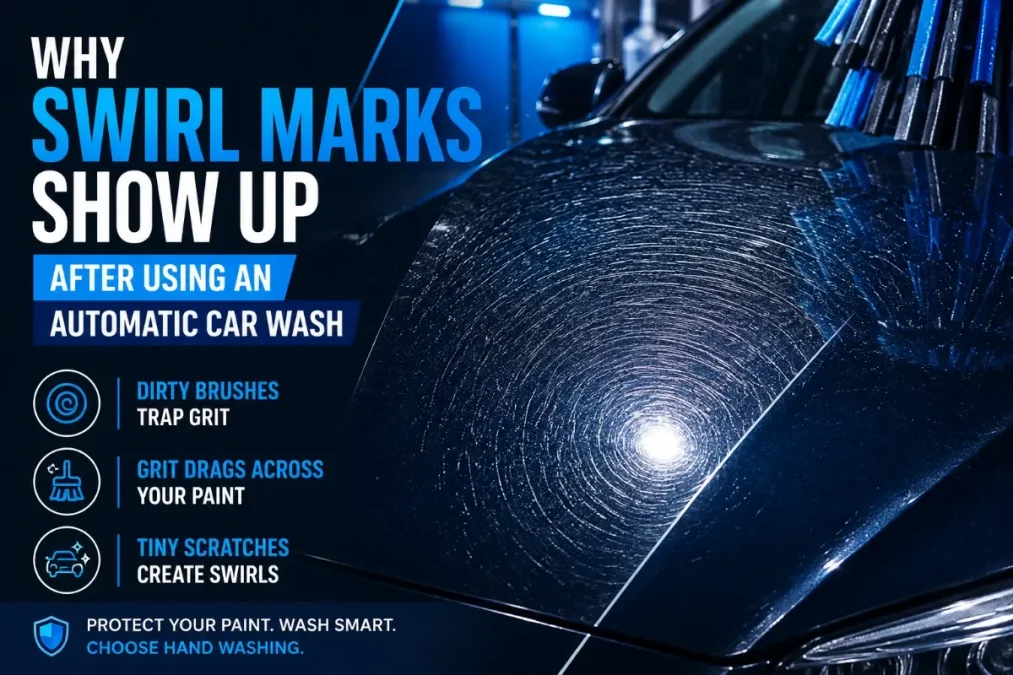
Most automatic tunnel washes use large spinning brushes or cloth strips to scrub the surface of every car that comes through. Here is the part that matters. Those same brushes touch hundreds of vehicles, one after another, without being replaced or fully cleaned between each one.
Every car that goes through picks up a small amount of dirt, grit, and road grime on its surface. Some of that grit transfers onto the brushes during the wash. Then it gets carried along and dragged across the next car’s paint, and the next one after that.
That trapped grit is what causes the scratching. It is not the brush material itself that is the main problem, it is the fine dirt particles riding along on the brush that act almost like sandpaper as they move across the clear coat. This is the exact mechanism behind most automatic car wash swirl marks, not a one-time accident but a repeated process every time a car goes through.
Why This Happens Even If Your Car Looked Clean Going In
A car does not need to look dirty for this to happen. Even a light layer of dust, pollen, or fine road film, the kind you cannot easily see, is enough grit to cause scratching when it gets dragged across the paint under pressure.
This is part of why a car can go through the same automatic wash dozens of times and gradually pick up more and more swirl marks, even if it looked reasonably clean before every single wash.
Touchless Washes Are Not Automatically Safer
Some automatic washes are labeled touchless, meaning no brushes touch the car at all. These rely on stronger water pressure and chemical cleaners instead. This does remove the brush-related scratching risk, but touchless washes generally do not clean as thoroughly, especially on bonded dirt and grime that needs some physical agitation to actually lift off.
In other words, touchless washes trade away some of the scratching risk for a less complete clean. Neither type fully solves the automatic car wash swirl marks problem on its own.
Why Hand Washing Is Different
A proper hand wash uses a clean wash mitt and fresh water, rather than a shared brush that has already touched other vehicles. The two-bucket method is the standard approach professionals use. One bucket holds clean soapy water. The other holds plain water for rinsing the wash mitt between sections of the car.
Rinsing the mitt in a separate bucket, instead of dipping it straight back into the soap, keeps the grit that has already been picked up out of the soap water. That means the next section of paint gets touched with a cleaner mitt, not one dragging the same dirt around the car over and over.
This is the main reason a proper hand wash causes far fewer swirl marks over time than repeated trips through an automatic tunnel wash.
Can Swirl Marks Be Prevented Completely?
Realistically, no. Even careful hand washing can introduce a small amount of fine scratching over months and years, since any contact between a cloth and a painted surface carries some risk. The goal is not zero swirl marks ever. It is keeping them to a minimum and using techniques that add far fewer than an automatic wash does.
A few habits help beyond just how the car gets washed. Drying with a clean microfiber towel instead of letting a car air dry reduces water spotting, which can also make existing swirl marks more noticeable. Avoiding wiping dust off with a dry cloth, which drags grit across the surface the same way a dirty automatic wash brush does, helps too.
What To Do If Automatic Car Wash Swirl Marks Are Already There
Swirl marks that are already in the clear coat will not go away on their own, no matter how careful your washing routine becomes going forward. Washing more gently going forward stops new damage from building up, but it does not undo scratches that are already there.
Removing existing swirl marks takes a process called paint correction. This uses a machine polisher and the right compound to carefully remove a very thin layer of the clear coat, taking the scratched layer with it and leaving a smooth, clear surface behind. Lighter swirling usually needs a single polishing pass. Heavier or long-term swirling, the kind that builds up after years of automatic washes, often needs a few passes with different compounds to fully clear.
Once the paint is corrected, adding a layer of protection, either a sealant or a longer-lasting ceramic coating, helps keep new swirl marks from building up as quickly, especially if you plan to keep hand washing going forward instead of returning to an automatic wash.
The Bottom Line
Automatic car washes are not a mistake to feel bad about using. They are fast, affordable, and convenient, especially for routine dirt and dust. But if you care about how your paint looks under direct light, understanding what those shared brushes are actually doing helps explain why automatic car wash swirl marks show up over time, and why switching to hand washing going forward makes a real difference.
If your car already shows swirl marks that bother you, our Paint Correction service can remove them and restore a clear, even finish. Going forward, our Exterior Detailing service uses the two-bucket hand wash method described above, which is a big part of keeping new swirl marks from building up in the first place.