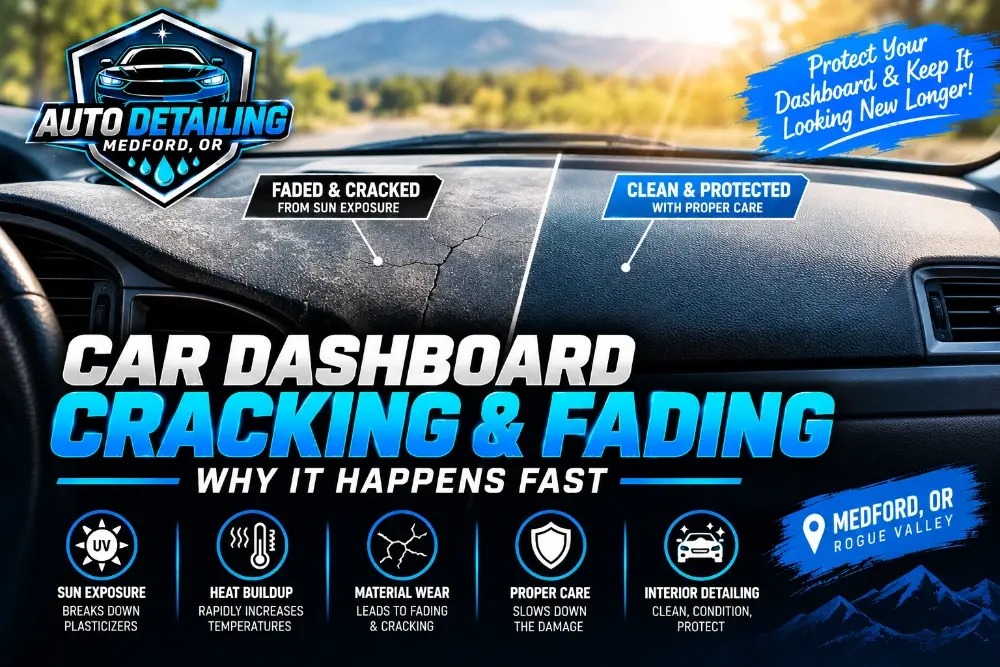
Why Medford’s Sun Cracks and Fades Your Dashboard So Fast
A new car’s dashboard is smooth, dark, and even in color. Give it a couple of summers parked outside in Medford, and it can start to look chalky, faded, or even develop small cracks along the surface. Car dashboard cracking and fading like this happens to plenty of well-maintained cars, and it is not a sign that anything was done wrong.
It comes down to how much direct sun your dashboard actually deals with, and Southern Oregon gives it more of that than a lot of other places.
Your Windshield Works Like a Magnifying Glass
A car’s windshield does something most people never think about. It lets sunlight pass through, but it also concentrates and directs a lot of that light and heat straight down onto the dashboard underneath it.
On a hot, sunny day, dashboard surface temperatures inside a parked car can climb well past the outside air temperature, sometimes hot enough to be uncomfortable to touch. That heat, combined with direct UV exposure, hits the same spot on the dashboard for hours at a time, every single day the car sits outside in the sun.
Medford’s long, dry summer stretch means a lot of days with strong, direct sunlight. A dashboard here takes on more cumulative heat and UV exposure over a summer than the same dashboard would in a cloudier or shorter-summer region.
What Actually Happens to the Material
Most dashboards are made from plastic, sometimes covered with a vinyl or synthetic layer. These materials contain oils and plasticizers, ingredients that keep the material flexible instead of stiff and brittle.
UV exposure breaks down those oils over time. As they degrade, the material loses flexibility and starts to dry out, which is exactly what leads to that faded, chalky look. Once the material has dried out enough, actual cracking often follows, especially along stress points near vents, gauges, or wherever the dashboard flexes slightly with temperature changes. This breakdown of oils and plasticizers is the actual mechanism behind car dashboard cracking and fading, not just surface dirt or normal wear.
This is a one-way process. Once the plasticizers have broken down and the material has dried out, no amount of cleaning brings that flexibility back.
Why This Happens Faster on Some Cars Than Others
A few factors make this process move quicker or slower.
Parking location. A car parked in direct sun all day, every day, takes far more cumulative UV exposure than one that spends most of its time in a garage or under any kind of shade.
Windshield angle and size. Some vehicles have windshields with a steeper angle or larger surface area, which can direct even more concentrated light onto the dashboard than a more upright windshield does.
Dashboard color. Darker dashboard materials absorb more heat than lighter ones, for the same basic reason dark paint gets hotter than light paint. A black dashboard in direct Medford sun runs hotter than a tan or gray one in the same spot.
Whether anything has ever been applied for protection. A dashboard that has had zero protective treatment over its life breaks down faster than one that has had some kind of UV protectant applied regularly.
Common Habits That Don’t Really Help
A few things people try do not do much against this specific kind of damage.
What Actually Helps Slow Car Dashboard Cracking and Fading Down
1. Using a windshield sunshade consistently
This is one of the simplest and most effective habits, since it blocks a large amount of direct sun before it ever reaches the dashboard. The tradeoff is that it only works when you remember to use it every time.
2. Parking in shade or a garage when possible
Even partial shade during the hottest parts of the day meaningfully reduces the total UV exposure a dashboard takes on over a summer.
3. Applying a proper UV protectant designed for interior surfaces
These products are made to help replace some of what plain cleaning cannot, adding a layer of UV resistance to the material’s surface. They need to be reapplied periodically to keep working, since the protection does wear off with sun exposure and cleaning over time.
4. Keeping the dashboard genuinely clean, not just wiped
Dust and grime sitting on top of a dashboard can trap heat against the surface. Regular, proper cleaning with the right products helps the material handle sun exposure a little better than a dashboard that is also dealing with a layer of built-up dust and grime on top of the UV problem.
What If the Cracking Has Already Started
Once a dashboard has visible cracks, there is no cleaning product or conditioner that reverses that. At that point, the realistic options are living with it, having it professionally repaired with a dashboard restoration process in more severe cases, or replacing the dashboard cover entirely, which is a bigger job than a standard detail covers.
The more practical goal for most drivers is protecting a dashboard that has not reached that point yet, since prevention is far easier and cheaper than trying to fix cracked or badly faded material after the fact.
Where This Leaves You
A faded or cracking dashboard is not really about how carefully you have taken care of your car. It is mostly about how much direct Medford sun that dashboard has absorbed over its life, and whether anything has ever been done to help it handle that exposure.
Our Interior Detailing service includes proper dashboard and console cleaning and conditioning as a standard part of every visit, using products meant to help interior surfaces hold up against Oregon’s sun rather than just wiping away dust. If your interior and exterior both need attention at the same time, our Full Auto Detail service covers both in a single appointment.
Starting protection early, before any fading or cracking shows up, is always the better position to be in. A dashboard that has never had any UV protection applied tends to show visible wear noticeably sooner than one that has been cared for consistently from the start.
This is one of those problems that is easy to ignore simply because it happens slowly. There is no single day where a dashboard suddenly looks bad. It fades a little more each summer until, eventually, the change is obvious. Catching it early, before cracking sets in, is really the only stage where much can be done about it.