Car Detail Checklist: What to Look at Before You Pay
Most people hand over their keys, come back to a shiny car, and say thank you. A good car detail checklist takes about five minutes at handoff and tells you whether the job was really finished. Here is what to look at, in the order that makes the most sense.
When should you inspect a detailed car?
Before you pay, and in daylight. Interior lights and shop lighting hide streaks, haze and leftover residue that show up right away in sun. In Medford, that means walking around the car outside, ideally in open light and not under a carport, since our bright summer sun shows everything.
Using a Car Detail Checklist: Start Outside, Then Move In
Walk the car once at a normal distance, then again up close. Crouch down to look along the side of the paint, because a low angle shows residue and water spots that a straight-on look misses.
Exterior Spots That Often Get Missed
These are the places people discover at home, a day later.
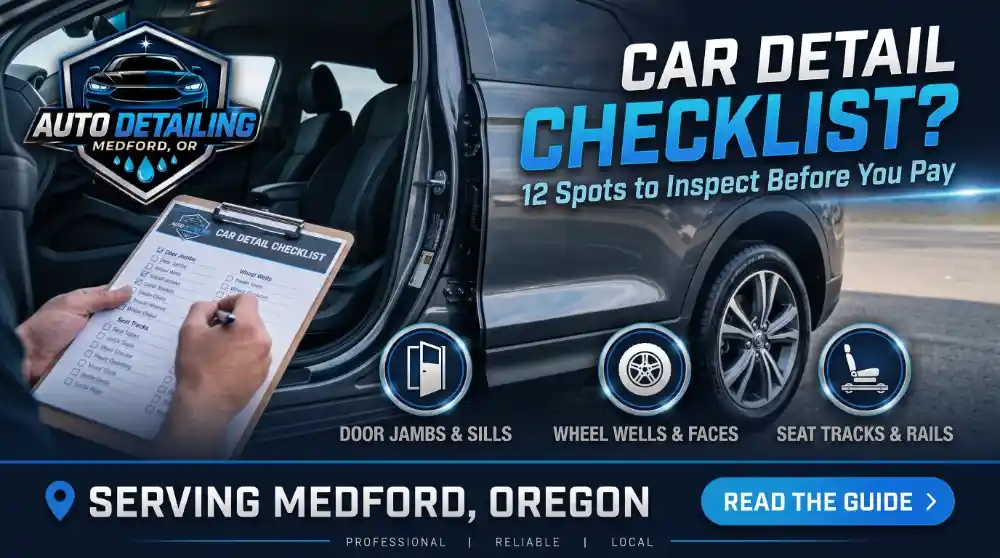
- Door jambs and sills. Open each door. The painted edge inside the frame should be wiped clean, with no grease or old wax lines.
- Wheel wells. Look up inside the fender, behind the tire. Mud and gravel dust here mean the job stopped at the wheel face.
- Wheel faces and barrels. Brake dust hides in the spokes and in the back of the wheel. Look through the gaps.
- Mirrors and trim edges. Dust and old polish like to sit where trim meets paint and around the base of mirrors.
- Gas cap area. Open the fuel door. It is small, but it is a good sign of whether someone paid attention.
- Water spots. Look at the glass and the flat panels. In the Rogue Valley, hard-edged white rings often come from drying water, and they should not be there after a proper hand dry.
- Haze or smears on paint. Wax, sealant or polish left on too long looks like a cloudy patch. It should wipe off with a clean towel.
Interior Spots That Often Get Missed
The inside is where a rushed job is easiest to hide.
- Seat tracks and under the seats. Move the seat forward and back. Crumbs and grit love the rails.
- Vents, cup holders and door pockets. Run a fingertip through them. They should feel clean, not gritty or sticky.
- Pedals and floor mats. Feel the pedals and look at the mat surface. They should not be greasy or slick. If your foot slides, say so before you leave.
- Inside of the glass. Look at the corners and along the edges where the glass meets the dash. Streaks often stay there. A low sun angle shows them best.
- Seats and carpet. If seats were shampooed, look for leftover rings. They should be drying evenly, not dark in patches.
Take your time. A real detail does not feel rushed at the walkthrough, and a good detailer will not mind you looking closely.
Why Spots Get Missed in the First Place
It helps to know why this happens, so you do not take it personally. A detailer works panel by panel, and most products look fine while the surface is still wet. Wax haze, cleaner residue and water spots often only show once everything dries. On a hot Medford afternoon, that can take minutes. A spot that looked clean at 2:10 can look streaked at 2:25.
Tight areas are the other reason. Door jambs, seat rails and wheel barrels are slow, awkward work, and they are the first thing to get shortened when someone is rushing. That is why a short, steady walkaround at the end catches what a quick glance does not.
What a Finished Car Should Feel Like
Checklists help, but your senses help too. The cabin should smell clean, not like heavy perfume. Surfaces should feel dry and a little matte, not oily. Glass should look clear from the driver’s seat at a normal angle. Paint should feel smooth when you run the back of your fingers across the hood.
Smell deserves a second look too. If you booked odor work or had a smoky season, sit inside with the doors closed for a minute. A faint smoke or musty note that is still there means the source was not fully treated, and that is worth raising politely before you pay.
If something about the car feels off but you cannot name it, say so. A quick second wipe is usually easy to do while you are standing there.
What a Full Detail Does Not Include
Part of a fair inspection is knowing what you should not expect. A standard full detail cleans and protects. It does not remove deep scratches, fix faded or cracked plastic, repair torn upholstery or take out burns. Those need other services, like paint correction or trim restoration, and they are quoted separately.
Set-in stains and old odors can also need extra work. If you asked about them, the detailer should have told you ahead of time what was realistic. If not, ask. Our Full Auto Detail page explains what the service covers, so you can compare it to what you got.
How to Bring Up a Problem Without Making It Awkward
Most missed spots are honest oversights, not bad intent. The best time to mention one is right then, politely, before you drive away.
- Point to the exact spot, like “the passenger door jamb still has some grease.”
- Ask if it can be wiped now.
- If it is something bigger, like a stain or smell, ask what the next step is.
A good detailer wants to fix it on the spot. If a shop dismisses the problem, that tells you something too.
Mobile Detailing Makes the Walkaround Easier
When the detailer comes to your driveway or workplace, you get to inspect the car in your own light, at your own pace, with no shop lighting hiding anything. Ask for the car to be left outside for the final look, even if it was worked on in the shade. If it was done in a garage, roll it out into the sun before you sign off. A few minutes of open light is the best quality check you have.
Photos Help for Next Time
Take a few quick photos of the jambs, wheels and seats before the detail starts and again after. You do not need anything fancy. It gives you a clear before and after, and it makes any conversation about missed spots simple and fair for both sides.
Setting Up Your Next Detail
A good car detail checklist is also useful when you book. If you know the places you care about, such as pet hair around the seat tracks or mud in the wheel wells, mention them on the call. Our Interior Detailing and Exterior Detailing pages list what each one covers, and our Pricing page shows typical ranges, so there are no surprises on either side.
Keep this car detail checklist on your phone. The next time you pick up a freshly detailed car, you will know exactly what to look at.